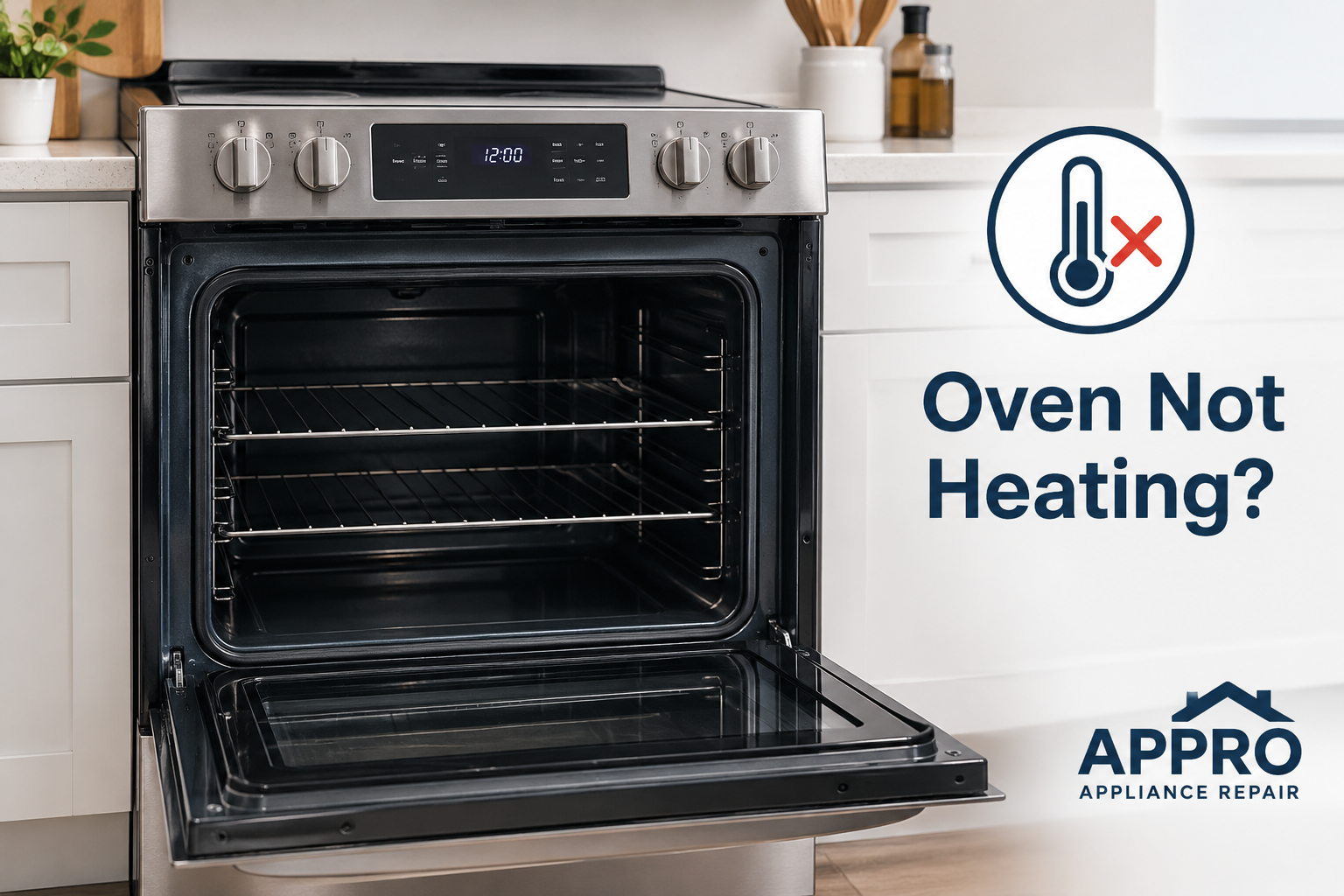
Few things disrupt a household like an oven that won’t heat. Dinner plans stall, holiday baking gets stressful, and you’re left wondering whether it’s a quick fix or a major expense. The good news is that most heating failures trace back to a handful of common parts. This guide covers the likely causes, what you can safely check yourself, and when professional oven repair is the smarter move. It reflects updated 2026 appliance safety guidance.
Why Your Oven Isn’t Heating: Common Problems Behind Oven Repair Calls
Understanding what’s failing helps you decide between a DIY check and a service call. These are the culprits technicians see most often in appliance repair oven visits:
Faulty bake element (electric ovens): The bake element is the heating coil at the bottom of the oven. Over time it develops cracks, blisters, or breaks, and the oven stays cold or heats weakly.
Failed igniter (gas ovens): A weak igniter can’t draw enough current to open the gas valve. The oven clicks or glows but never lights.
Broken temperature sensor: If the sensor sends wrong readings, the oven may shut off early or never reach the set temperature.
Defective thermostat or control board: Electronic controls fail from heat, power surges, and age, leaving the oven unresponsive or inaccurate.
Tripped breaker or power issue: Electric ovens need a dedicated 240-volt circuit. A tripped breaker or blown fuse can cut heating while the clock and lights still work.
Faulty door latch or switch: Some models won’t heat if the door doesn’t register as closed.
Quick Checks Before You Call
Try these safe steps first:
Check the breaker. Reset it once. If it trips again, stop and call a professional.
Confirm the settings. Make sure the oven isn’t in sleep, demo, or timer-delay mode.
Inspect the bake element. With the oven off and cool, look for visible breaks or blistering.
Test another burner (gas ovens). If the cooktop works, the gas supply is likely fine.
Check temperature accuracy. An inexpensive oven thermometer shows whether the oven is heating at all or just running cool.
Safety first: If you smell gas, leave the home and call your gas provider immediately. Current 2026 guidance from appliance safety organizations is clear that gas odors and repeated breaker trips should never be handled as DIY projects.
Choosing a Professional Oven Repair Service Near You
If the quick checks don’t solve it, a professional oven repair service saves time and prevents costly mistakes. Oven repairs involve high-voltage wiring, gas lines, and sealed components, and a wrong move can void a warranty or create a hazard. A trained technician can diagnose the issue in a single visit, often fixing it on the spot with a stocked truck of common parts.
When Oven Appliance Repair Beats Replacement
A good rule of thumb: if your oven is under 10 to 12 years old and the repair costs less than half the price of a new unit, repair usually wins. Elements, igniters, sensors, and switches are affordable fixes that can add years of reliable use. Replacement makes more sense when the oven is well past its expected lifespan or has multiple failing components. At APPRO Appliance, our technicians give you an honest repair-versus-replace recommendation, so you never pay for work you don’t need.
What to Expect From Our Oven Repair Service
When you book with us, you get a straightforward process:
Upfront diagnosis: We identify the exact cause before any work begins.
Transparent pricing: You approve the estimate before we start.
Quality parts: We use manufacturer-grade replacements backed by a warranty.
Brands we service: Whirlpool, GE, Samsung, LG, Frigidaire, Bosch, KitchenAid, and more.
Same-day or next-day appointments when availability allows.
Schedule Your Oven Repairs With APPRO Today
Don’t let a cold oven put your kitchen on hold. Contact APPRO for fast, reliable oven repairs from licensed technicians who treat your home with care. Call or book online, and we’ll get your oven heating again, safely and correctly.
Keeping Your Oven Running Longer
A little maintenance goes a long way. Wipe spills promptly, since baked-on residue can damage elements and sensors. Avoid slamming the door, and never line the oven floor with foil, which can block airflow and damage heating parts. Have your oven inspected every couple of years, especially if it’s heavily used. Following updated 2026 manufacturer care recommendations helps catch small problems before they become expensive failures.
An oven that won’t heat is frustrating, but it’s rarely hopeless. Whether the cause is a worn element, a failing igniter, or a faulty sensor, the right diagnosis points you to the right fix.
Protect Your House Inside and Out
A well-kept kitchen is only part of a well-kept home. While your appliances are running smoothly inside, don’t forget the outside, where fresh paint protects your siding, trim, and curb appeal from the elements. For professional interior and exterior painting that lasts, visit El Royale Painting and give your home the finish it deserves.